

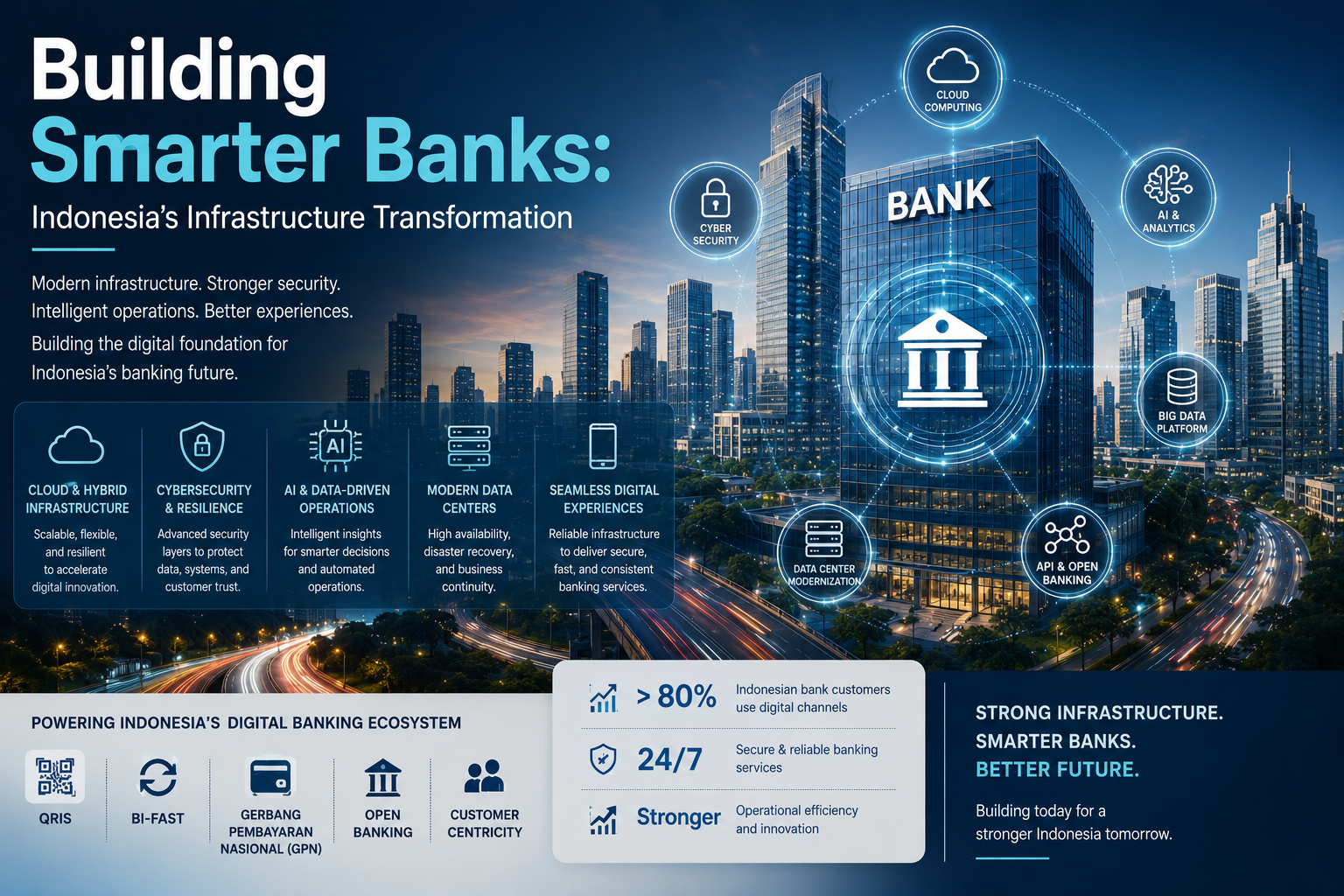
Indonesia’s banking industry is undergoing one of the most significant technology transformations in its history. As digital banking, real-time payments, artificial intelligence (AI), and fintech ecosystems continue to expand, financial institutions are investing heavily in modern IT infrastructure to improve operational resilience, enhance cybersecurity, and deliver seamless digital experiences.
Today, IT infrastructure is no longer viewed merely as a supporting function. Instead, it has become a strategic business asset that enables banks to innovate faster, comply with increasingly complex regulations, and compete in an increasingly digital financial landscape. From cloud computing and software-defined data centers to AI-powered operations and hybrid cloud environments, Indonesian banks are redefining the technological foundation of modern financial services.
The rapid adoption of mobile banking, digital payments, QRIS, BI-FAST, and Open Banking has fundamentally changed infrastructure requirements. Traditional legacy systems that once supported branch-centric operations are now being replaced by cloud-ready, API-driven, and highly scalable architectures capable of processing millions of transactions in real time. Modern banking infrastructure must support:
- 24/7 digital banking availability
- Real-time payment processing
- High transaction throughput
- Omnichannel customer experiences
- Advanced cybersecurity
- Regulatory compliance
- Business continuity and disaster recovery
As customer expectations continue to evolve, infrastructure modernization has become essential for maintaining competitiveness in Indonesia’s fast-growing digital economy.
Modern Data Centers: The Foundation of Digital Banking
Data centers remain the backbone of banking operations. Banks are investing in high-availability facilities equipped with redundant power systems, advanced cooling technologies, and multiple network connections to ensure uninterrupted service. Key characteristics of modern banking data centers include:
- Tier III and Tier IV infrastructure
- High Availability (HA)
- Disaster Recovery (DR)
- Geographic redundancy
- Energy-efficient operations
- Continuous monitoring
- Physical and cyber security integration
These facilities support mission-critical applications, payment platforms, core banking systems, and customer-facing digital services while maintaining strict service-level agreements (SLAs). Cloud computing has become one of the most transformative technologies in Indonesia’s banking sector.
Rather than migrating entirely to public cloud environments, many banks are adopting hybrid cloud strategies that combine private cloud, public cloud, and on-premises infrastructure. This approach enables financial institutions to:
- Scale computing resources dynamically
- Accelerate application deployment
- Improve disaster recovery capabilities
- Optimize infrastructure costs
- Support AI and analytics workloads
- Maintain regulatory compliance through data residency
Hybrid cloud also enables banks to modernize legacy applications gradually without disrupting existing operations. The next generation of banking infrastructure is increasingly software-defined.
Technologies such as Software-Defined Networking (SDN), Software-Defined Storage (SDS), and hyperconverged infrastructure allow banks to automate infrastructure management while improving flexibility and resource utilization. Benefits include:
- Faster provisioning
- Automated resource allocation
- Simplified infrastructure management
- Improved scalability
- Reduced operational complexity
- Lower total cost of ownership
Infrastructure automation enables IT teams to focus on innovation rather than manual system administration.
Cybersecurity as Core Infrastructure
As cyber threats continue to evolve, cybersecurity has become an integral component of banking infrastructure rather than an independent security function. Modern banking environments implement multilayered security architectures including:
- Zero Trust Security
- Identity and Access Management (IAM)
- Multi-Factor Authentication (MFA)
- Security Information and Event Management (SIEM)
- Security Operations Centers (SOC)
- Extended Detection and Response (XDR)
- Data encryption at rest and in transit
- AI-powered threat detection
These technologies help protect customer information, payment systems, and digital banking platforms against increasingly sophisticated cyberattacks.
Artificial Intelligence is transforming infrastructure management through AIOps (Artificial Intelligence for IT Operations). Banks increasingly utilize AI to:
- Predict infrastructure failures
- Automate incident response
- Optimize resource utilization
- Detect anomalies
- Improve network performance
- Reduce downtime
- Accelerate root-cause analysis
Predictive analytics enables infrastructure teams to identify potential issues before they impact customers, significantly improving operational resilience. For financial institutions, uninterrupted service is a critical requirement.
Banks therefore invest extensively in Business Continuity Management (BCM) and Disaster Recovery (DR) capabilities. Modern disaster recovery strategies typically include:
- Active-active data centers
- Active-passive replication
- Real-time database synchronization
- Automated failover
- Regular disaster recovery testing
- Cloud-based backup solutions
These capabilities ensure that banking services remain available even during natural disasters, cyber incidents, or infrastructure failures. Indonesia’s payment ecosystem—including QRIS, BI-FAST, the National Payment Gateway (GPN), and Open Banking initiatives—requires highly resilient, secure, and scalable IT infrastructure.
Banks must process millions of daily transactions while maintaining low latency, high availability, and robust security. Infrastructure modernization therefore plays a central role in supporting the country’s digital financial ecosystem and enabling collaboration among banks, fintech companies, and payment service providers.
Regulatory Compliance and Governance
Infrastructure modernization must align with regulations issued by Bank Indonesia (BI), the Financial Services Authority (OJK), and other relevant authorities. Banks continuously strengthen governance through:
- Information security management
- Data governance
- Risk management
- Operational resilience
- Audit readiness
- Privacy protection
- Technology risk management
Compliance is increasingly integrated into infrastructure architecture from the design stage, ensuring that innovation does not compromise security or regulatory obligations.
The future of banking infrastructure in Indonesia will be increasingly cloud-native, intelligent, and automated. Emerging technologies expected to shape the next decade include:
- Artificial Intelligence and Generative AI
- Cloud-native core banking platforms
- Edge computing
- Kubernetes and container orchestration
- Infrastructure as Code (IaC)
- Quantum-resistant cybersecurity
- Digital identity platforms
- Sustainable Green Data Centers
- Autonomous IT Operations (AIOps)
Banks will continue evolving toward software-defined, API-driven, and AI-enabled infrastructure capable of supporting real-time financial services at national scale.
Indonesia’s banking industry is entering a new era in which IT infrastructure serves as the foundation of innovation, resilience, and customer trust. Investments in modern data centers, hybrid cloud environments, cybersecurity, automation, and artificial intelligence are enabling banks to deliver secure, reliable, and highly scalable digital services.
As the country’s digital economy continues to expand, robust IT infrastructure will remain a critical competitive advantage. Institutions that successfully modernize their technology foundations while maintaining strong governance and regulatory compliance will be best positioned to lead Indonesia’s future financial ecosystem and support sustainable economic growth.
Editor: Rachmat Adhani (Business Development Manager Ocean Innovation)