

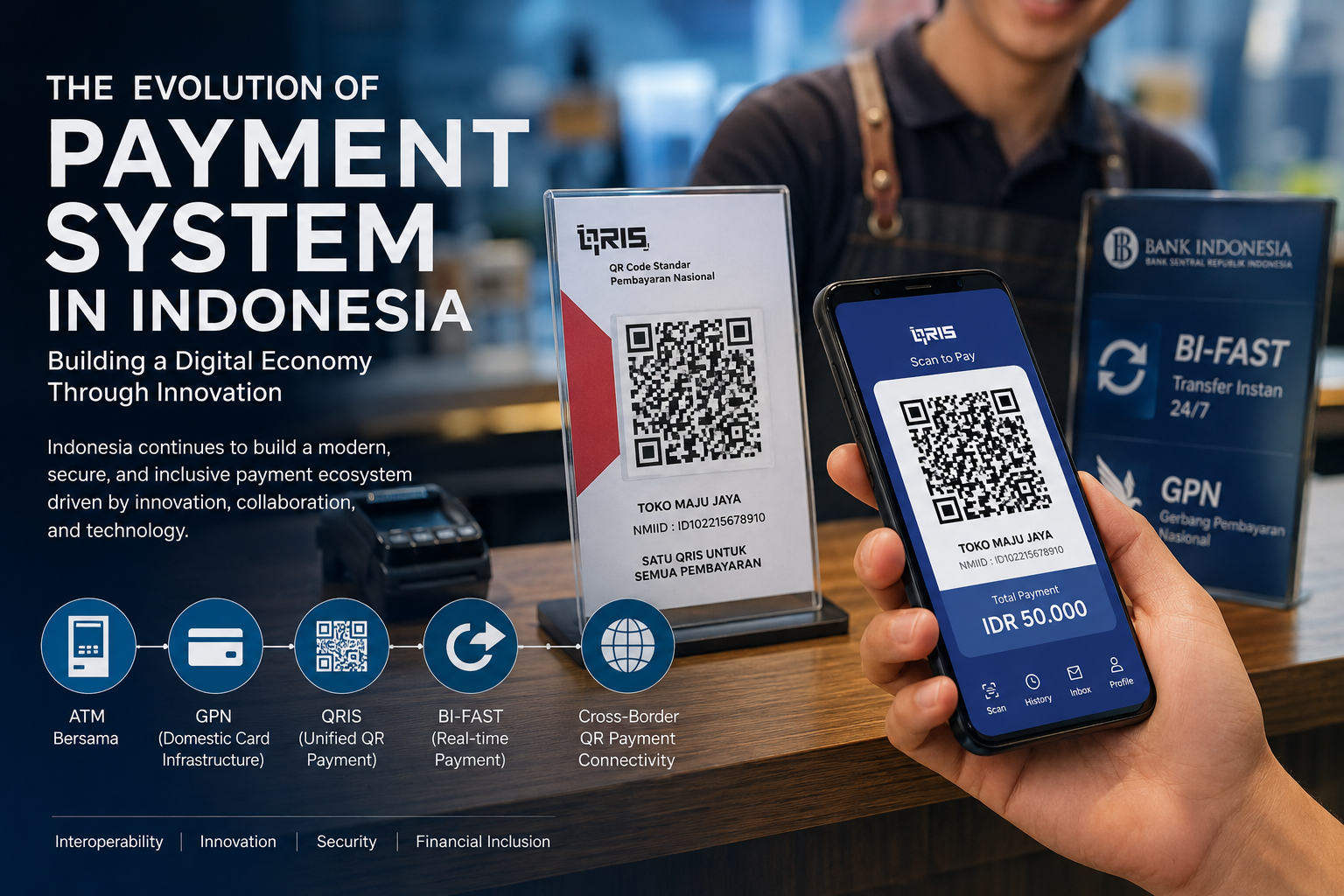
Indonesia has undergone one of the most significant payment system transformations in Southeast Asia over the past decade. As the world’s fourth most populous nation and the largest economy in the region, Indonesia has embraced digital payment technologies to support financial inclusion, improve transaction efficiency, and strengthen economic resilience.
Driven by rapid smartphone adoption, expanding internet access, and supportive regulatory policies, the country’s payment ecosystem has evolved from predominantly cash-based transactions to a modern, interoperable digital payment infrastructure. Today, millions of Indonesians use mobile banking, electronic wallets, QR code payments, and instant fund transfers as part of their daily lives. The transformation has positioned Indonesia as one of Asia’s leading digital payment markets.
For many years, cash remained the dominant payment instrument in Indonesia. However, the rapid growth of e-commerce, digital banking, and fintech companies created strong demand for faster, safer, and more convenient payment solutions.
The COVID-19 pandemic further accelerated digital payment adoption as consumers and businesses increasingly preferred contactless transactions. Small and medium-sized enterprises (SMEs), which previously relied heavily on cash, rapidly adopted digital payment platforms to serve customers more efficiently and participate in the growing digital economy.
Bank Indonesia’s Vision for a Modern Payment System
The transformation has been led by Bank Indonesia through the Indonesia Payment System Blueprint (BSPI) 2025. The blueprint outlines a comprehensive strategy to modernize the national payment ecosystem by emphasizing digital innovation, interoperability, cybersecurity, and financial inclusion. Its primary objectives include:
- Building an integrated national payment infrastructure.
- Supporting innovation through Open Banking and API-based services.
- Strengthening data governance and cybersecurity.
- Promoting competition while maintaining financial stability.
- Expanding access to digital financial services across Indonesia’s archipelago.
This strategic framework has encouraged collaboration among banks, fintech companies, payment service providers, and technology firms, creating a more connected financial ecosystem. One of Indonesia’s most successful payment innovations is the Quick Response Code Indonesian Standard (QRIS). Introduced by Bank Indonesia in 2019, QRIS standardized QR-code payments across all licensed payment service providers.
Before QRIS, merchants often displayed multiple QR codes from different payment providers. QRIS solved this problem by enabling consumers to pay using any participating banking application or electronic wallet through a single standardized QR code.
The benefits of QRIS include:
- Interoperability among banks and e-wallets.
- Faster merchant onboarding.
- Lower infrastructure costs for micro and small businesses.
- Greater financial inclusion.
- Improved transaction transparency and efficiency.
Millions of merchants now accept QRIS, with the vast majority consisting of MSMEs, making it one of the world’s largest unified QR payment ecosystems. Cross-border QRIS interoperability has also expanded with several neighboring countries, supporting tourism and international commerce.
Another major milestone is the implementation of BI-FAST, Indonesia’s real-time retail payment infrastructure. BI-FAST enables instant interbank fund transfers with lower transaction costs and continuous availability. Compared with traditional transfer systems, BI-FAST offers:
- Real-time settlement.
- Lower transaction fees.
- High system availability.
- Secure and reliable infrastructure.
- Support for future payment innovations.
The system has become a critical component of Indonesia’s digital financial infrastructure, facilitating both consumer and business transactions while improving operational efficiency across the banking industry.
Indonesia has also strengthened its domestic payment ecosystem through the National Payment Gateway (Gerbang Pembayaran Nasional or GPN).
GPN integrates domestic debit card transactions across multiple banks and switching providers, reducing dependence on international payment networks for local transactions. The initiative enhances payment efficiency, supports domestic processing, and contributes to greater national payment sovereignty. Together, GPN, QRIS, and BI-FAST form the foundation of Indonesia’s integrated retail payment ecosystem.
The Rise of Digital Wallets and Fintech
Indonesia’s payment transformation has been further accelerated by the rapid growth of electronic wallets and fintech companies. Digital wallets have become an integral part of everyday life, supporting:
- Retail purchases
- Online shopping
- Transportation
- Food delivery
- Utility bill payments
- Government services
- Peer-to-peer transfers
The combination of mobile banking, QRIS, and digital wallets has significantly reduced barriers to cashless transactions while encouraging broader participation in the formal financial system. Indonesia is also expanding payment interoperability beyond its national borders.
Bank Indonesia has collaborated with several countries to enable cross-border QR payments, allowing travelers and businesses to make transactions using domestic payment applications abroad. This initiative supports tourism, regional trade, and ASEAN financial integration while reducing dependence on cash and foreign exchange during travel.
Cross-border interoperability represents an important step toward creating a seamless regional payment ecosystem.
Challenges in the Digital Payment Era
Despite remarkable progress, Indonesia continues to face several challenges:
- Increasing cybersecurity threats.
- Digital fraud and financial crime.
- Uneven digital literacy.
- Infrastructure disparities across remote regions.
- Balancing innovation with regulatory compliance.
To address these issues, regulators continue to strengthen governance, cybersecurity standards, consumer protection frameworks, and digital identity verification systems while encouraging responsible innovation throughout the financial sector.
Indonesia’s payment system is expected to become increasingly intelligent, interconnected, and data-driven. Emerging technologies such as Artificial Intelligence, cloud computing, Open APIs, tokenized payments, and digital identity solutions will further enhance the speed, security, and personalization of financial services. Future developments are likely to include:
- Wider adoption of AI-powered fraud detection.
- Expansion of embedded finance.
- Growth of Open Banking ecosystems.
- Greater cross-border payment interoperability.
- Enhanced real-time payment capabilities.
- Deeper integration between banks, fintech companies, and digital commerce platforms.
As digital transformation continues, Indonesia is well positioned to become one of Asia’s leading digital payment ecosystems. By combining strong regulatory leadership, technological innovation, and inclusive financial policies, the country is building a payment infrastructure that supports sustainable economic growth, financial inclusion, and global competitiveness in the digital era.
Editor: Rachmat Adhani (Business Development Manager Ocean Innovation)