

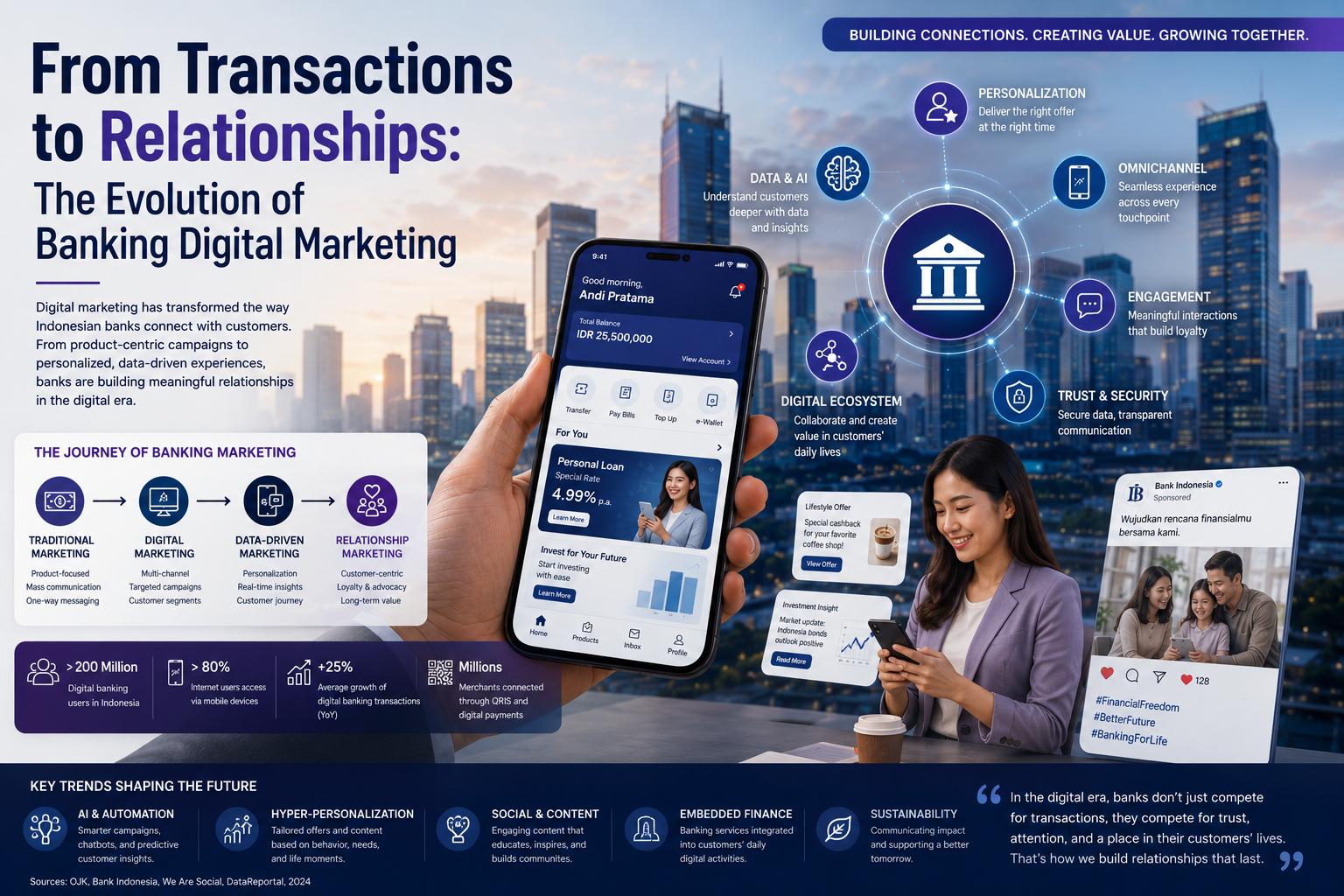
Indonesia’s banking industry has experienced a profound transformation in the digital era, not only in the way financial services are delivered but also in how banks engage with customers. Traditional marketing channels such as television, print media, and branch-based promotions have gradually evolved into highly personalized, data-driven digital marketing strategies powered by artificial intelligence (AI), big data analytics, and digital ecosystems.
As one of Southeast Asia’s largest digital economies, Indonesia provides enormous opportunities for banks to reach millions of digitally connected consumers. Increasing smartphone penetration, widespread internet access, growing social media usage, and the rapid adoption of digital banking services have fundamentally changed customer expectations and reshaped banking marketing strategies.
Historically, Indonesian banks relied heavily on physical branches, relationship managers, billboards, television commercials, and printed advertisements to promote financial products. While these channels remain relevant for brand awareness, today’s customers increasingly interact with banks through mobile applications, websites, social media platforms, and digital ecosystems.
This behavioral shift has encouraged banks to invest significantly in digital marketing technologies capable of delivering personalized customer experiences across multiple touchpoints. Digital marketing has become an essential component of customer acquisition, engagement, retention, and long-term relationship management.
Customer-Centric Marketing in the Digital Era
Modern banking marketing is no longer centered solely on promoting products. Instead, it focuses on understanding customer needs throughout their financial journey.
By utilizing customer analytics and behavioral insights, banks can recommend savings accounts, loans, credit cards, investment products, insurance, and wealth management services that align with individual preferences and financial goals. Personalized marketing campaigns are now delivered through:
- Mobile banking applications
- Email marketing
- Push notifications
- SMS campaigns
- Social media advertising
- Personalized website content
- Digital customer communities
These personalized interactions significantly improve customer engagement while increasing conversion rates and customer loyalty. Artificial Intelligence has become one of the most influential technologies shaping digital marketing in Indonesia’s banking industry. AI enables banks to:
- Analyze customer behavior in real time.
- Predict future financial needs.
- Recommend personalized products.
- Optimize advertising campaigns.
- Detect fraudulent activities.
- Automate customer interactions through intelligent chatbots.
- Improve customer segmentation.
Big data analytics allows banks to transform millions of customer transactions into valuable marketing insights, enabling more accurate targeting and more effective campaign performance. AI-driven marketing is increasingly viewed as a strategic capability for banks seeking sustainable growth.
Social media has evolved from a branding channel into a comprehensive customer engagement platform. Indonesian banks actively leverage platforms such as Instagram, TikTok, LinkedIn, Facebook, YouTube, and X to communicate with customers, promote financial literacy, introduce new digital products, and build stronger brand communities. Content strategies increasingly emphasize:
- Financial education.
- Investment awareness.
- Cybersecurity tips.
- Lifestyle-oriented banking.
- Entrepreneur support.
- Digital payment education.
- Sustainability initiatives.
Interactive content, short-form videos, webinars, podcasts, and live streaming have become effective tools for engaging younger audiences, particularly Millennials and Generation Z.
Omnichannel Customer Experience
One of the defining characteristics of modern banking marketing is the adoption of omnichannel strategies. Customers now expect seamless experiences regardless of whether they interact through:
- Mobile banking
- Internet banking
- Call centers
- Social media
- Branch offices
- Chatbots
- Video banking
- Messaging applications
Banks increasingly integrate customer data across these channels to ensure consistent communication, personalized recommendations, and uninterrupted customer journeys. The growth of digital ecosystems has expanded marketing opportunities beyond traditional banking services. Many Indonesian banks now collaborate with:
- E-commerce platforms
- Fintech companies
- Ride-hailing services
- Digital merchants
- Payment service providers
- Lifestyle applications
These partnerships allow banks to offer embedded financial services directly within customers’ daily digital activities, creating new opportunities for customer acquisition and cross-selling. As banks collect increasing volumes of customer data, responsible data governance has become an essential component of digital marketing.
Customers expect transparency regarding how their personal information is collected, processed, and protected. Banks therefore continue investing in:
- Data privacy frameworks.
- Customer consent management.
- Cybersecurity.
- Secure digital identity verification.
- Ethical AI governance.
Maintaining customer trust is increasingly recognized as a competitive advantage in digital marketing. OJK has also published guidance covering digital transformation, artificial intelligence governance, and the responsible use of social media in banking.
Challenges Facing Digital Marketing
Despite rapid progress, several challenges remain. Banks must balance personalization with privacy while responding to evolving customer expectations and intensifying competition from fintech companies and digital-native financial institutions. Other key challenges include:
- Increasing cybersecurity threats.
- Digital advertising fraud.
- Customer data protection.
- Marketing automation complexity.
- Rapidly changing social media trends.
- Measuring omnichannel campaign effectiveness.
- Regulatory compliance.
Successfully addressing these challenges requires continuous investment in technology, talent, governance, and customer experience. The future of digital marketing in Indonesia’s banking sector will be increasingly intelligent, predictive, and customer-centric.
Emerging technologies such as Generative AI, predictive analytics, conversational banking, hyper-personalization, and real-time customer engagement are expected to redefine how banks communicate with customers. Future marketing strategies will increasingly emphasize:
- AI-powered personalization.
- Predictive customer journeys.
- Embedded finance marketing.
- Real-time contextual offers.
- Sustainable finance campaigns.
- Financial literacy through digital content.
- Community-driven brand engagement.
As Indonesia’s digital economy continues to expand, banks that successfully combine technology, trusted customer relationships, and data-driven marketing will be better positioned to compete in an increasingly dynamic financial landscape. Supported by ongoing digital transformation initiatives and a growing digitally connected population, Indonesia’s banking industry is entering a new era where digital marketing serves not only as a promotional tool but as a strategic driver of customer experience, financial inclusion, and sustainable business growth.
Editor: Rachmat Adhani (Business Development Manager Ocean Innovation)